Why Your 1,500-Word Posts Won’t Save You From Quality Penalties
Word count is the most overrated SEO signal in 2026. Operators who watched their portfolios get demoted in the last twelve months keep telling the same story: “but the posts were 1,500 words.” That detail is offered as if it should have been a defense. It was not, because Google’s quality systems stopped scoring length as a primary signal years ago, and the operators who are still optimizing for it are optimizing for a metric that no longer correlates with the outcome they want.
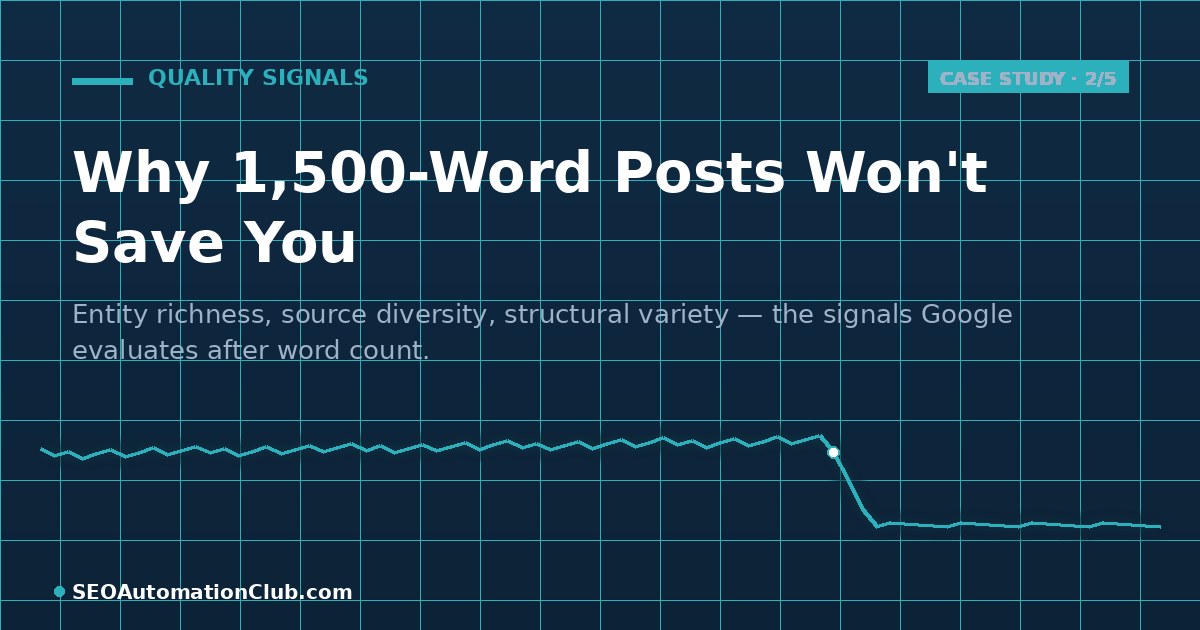
The case we examined in the previous post in this series made the point cleanly. A 1,200-post site with an average article length above 1,250 words lost 99.6% of its traffic in a single day. The pages that got demoted were not thin. They were long, templated, and structurally interchangeable. Meanwhile, in the same niche, sites publishing 600- to 900-word posts continued to rank in the top three. This post is about why that happens and what Google’s quality systems are actually evaluating once length stops being the variable.
The myth of the magic number
The 1,500-word target is a fossil. It comes from a 2010s era when most SERPs were dominated by thin affiliate posts, when “comprehensive” was a defensible synonym for “useful,” and when correlational studies kept reporting that longer pages ranked better. Those studies measured the wrong thing. Longer pages ranked better because, at the time, length was a proxy for effort, sourcing, and editorial care. Once an LLM made it trivial to produce 1,500 words on any topic in 30 seconds, the proxy broke. Length stopped tracking effort, and Google’s quality systems adjusted faster than the SEO industry did.
The result, in 2026, is a SERP where you can find top-three results that are 600 words long sitting above number-ten results that are 3,000 words long. The shorter posts are not winning because they are short. They are winning because the signals that actually drive ranking — entity coverage, source diversity, structural fit to intent, and demonstrated expertise — are all expressible in 600 words when the operator knows what they are doing, and routinely missing from 3,000-word AI output when they don’t.
What Google’s quality systems actually evaluate
Four signals do the heavy lifting once you remove length from the equation. None of them are exotic. All of them are auditable.
Entity richness
A page about, say, container orchestration that mentions Kubernetes, kubelet, etcd, control plane, pod, kube-proxy, CNI, and StatefulSet is doing entity work that a page on the same topic that only mentions Kubernetes is not. The classifier behind Google’s quality systems indexes entities, not keywords. A short post that names the relevant entities densely and accurately outperforms a long post that uses the same root keyword 40 times.
If you want a cheap audit signal, run your draft through an entity extractor and compare the entity set against the top three ranking pages for your target query. If your draft has half the entities of the SERP leaders, length will not save you.
Source diversity
Pages that cite multiple distinct, verifiable sources — primary documentation, peer-reviewed research, named experts, original data — read differently to the classifier than pages that paraphrase a single source or no source at all. Outbound links are not the metric; provenance is. A 700-word post that quotes a named study, links to the dataset, and references a domain expert by name accumulates signal a 3,000-word AI summary cannot replicate.
The corollary is brutal for operators who scaled with single-prompt AI workflows: a model writing in zero-shot mode does not cite sources, does not name researchers, and does not link to primary data. It produces fluent paragraphs that are structurally indistinguishable from every other fluent paragraph generated by the same model. The classifier sees this clearly.
Structural fit to intent
“How to” queries reward step-by-step structure. “Vs.” queries reward comparison tables. “What is” queries reward concise lead paragraphs that answer the question before sub-sections. “Best X for Y” queries reward bracketed recommendations with criteria.
Templated AI pipelines produce the same H2 outline regardless of intent. Every post becomes a seven-section explainer with a forced FAQ at the bottom, whether the query asked for a comparison or a definition. The classifier picks up the mismatch — not as a single-post error, but as a site-wide pattern: this domain produces the same structure for every intent, which means it is not actually fitting the user’s need on most queries.
Real expertise signals
This is the signal most operators dismiss because it sounds soft. It is not. Real expertise signals are concrete and machine-readable: a named author with a verifiable track record (and a /about page that establishes it), Person schema linking the author to their other work, references to firsthand experience (“when we ran this audit on a 1,200-post site”), specific numbers that are not round, and a willingness to take positions that a generic summary would never take.
A 700-word post written by a named expert who says “I disagree with the conventional wisdom on this and here is the data behind it” beats a 3,000-word post written by an anonymous brand voice that hedges on every claim. The first one has expertise signal. The second one does not, no matter how many words it contains.
A side-by-side comparison
Consider two posts on the same query — “how to set up canonical tags for paginated archives.” Both are technically correct. Both are well-written. One is 2,100 words; the other is 640.
| Signal | Templated 2,100-word post | Unique 640-word post |
|---|---|---|
| Entity coverage | 8 entities; same as 12 other site posts | 17 entities, including rel=prev/next, noindex,follow, view-all pattern |
| Sources cited | 0 | 3 (Google docs, an MDN page, a named blog post) |
| Structural fit | 7-section explainer + FAQ (site template) | Direct answer, one decision tree, one code block |
| Author signal | “by Editorial Team”, no schema | Named author + Person schema + /about page |
| Firsthand claims | None | “On the 4M-URL archive we tested, this configuration produced…” |
The 640-word post is the better page on every dimension the classifier rewards. The 2,100-word post is longer, and that is the only category in which it wins. In a SERP where these two are competing, the short post outranks the long one consistently.
A quality rubric you can use today
Replace the word-count check in your editorial process with a five-question rubric. A post should score positively on all five before it goes live.
- Entity density. Does this post name at least 80% of the entities that appear across the top three ranking pages for the target query? If not, the post is shallow on a signal Google’s classifier actively measures.
- Source provenance. Does this post cite at least two distinct, verifiable sources by name, with links? Wikipedia and competitor blog posts do not count; primary documentation, named research, original data, and named experts do.
- Structural fit. Does the structure of this post match the dominant structure in the SERP for the target intent? A how-to in a SERP of comparisons is misfit; a comparison in a SERP of how-tos is misfit.
- Expertise signal. Is there a named author with Person schema, a public /about page, and at least one firsthand claim in the post that demonstrates the author has done the thing they are writing about?
- Originality. Does this post contain at least one piece of information — a number, a quote, a decision rule, a screenshot, an example — that a reader cannot find anywhere else in the top ten results?
If a draft scores zero on three or more of these dimensions, adding 500 words will not save it. Cutting it to 600 words of useful content might.
Frequently asked questions
Does word count matter at all?
Yes, but not as a target. Word count is a downstream consequence of doing the underlying work — covering entities, citing sources, fitting the intent, demonstrating expertise. When you do that work, the length lands where it lands. A query about a single configuration flag should not require 2,000 words; a complex implementation guide will exceed 2,500 naturally. Treat length as an output, not a goal.
Are short posts safer from quality penalties?
Short posts are not safer because they are short. They are safer when they are genuinely useful — when they answer the question, cite sources, and demonstrate expertise. A site full of 400-word AI summaries with no sources will be demoted just as fast as a site full of 2,000-word ones. Length is not the variable.
How can I tell whether my posts have entity richness?
Run them through a named-entity recognizer (spaCy, an LLM extractor, or any commercial NLP tool) and compare the entity set against the top three SERP results. Sites with healthy entity richness match or exceed the SERP leaders. Sites with shallow content come in at 40–60% of the leader’s entity set.
Will adding Person schema fix a thin post?
No. Person schema is one of several E-E-A-T signals; on its own it does not rescue weak content. But on a portfolio of strong posts it amplifies them, and on a portfolio of weak posts its absence is one of the things that tells the classifier nobody is willing to put their name on the work.
What about pillar pages and long-form guides?
Those are legitimate formats — when the query warrants depth. The mistake is treating every query as a pillar opportunity. A pillar page on a topic that the SERP solves with a 600-word how-to will lose on intent fit no matter how well it is written.
What to do next
Stop tracking average word count as a quality KPI. Replace it with the five-point rubric above, and use it as a gate on every post that ships. The work feels harder because you cannot pad your way to compliance — but it is precisely the work the classifier is rewarding. We cover what comes next once a site has already been demoted in the 6-sprint recovery plan for algorithmically demoted sites.
Score every post against a real quality rubric, automatically
Donna SEO Ops evaluates every draft against entity richness, source diversity, structural fit, and expertise signals before it publishes. Request a free quality audit →