The Hidden Signature That Triggers Google’s Helpful Content Penalty (And It’s Not What You Think)
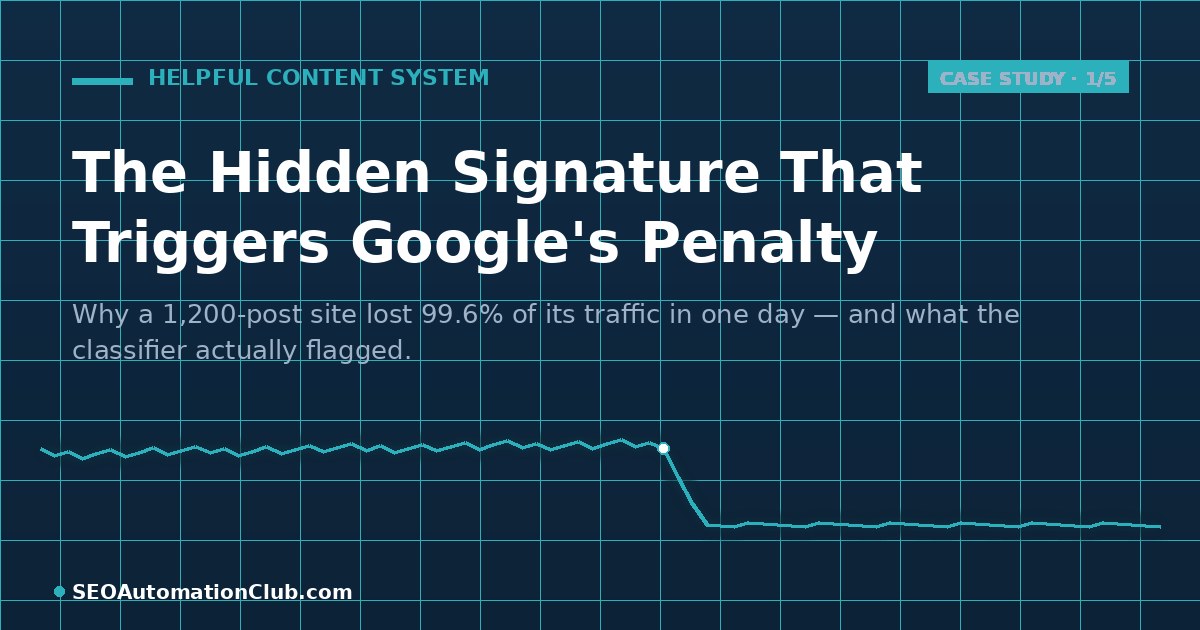
A 1,200-post site we audited recently lost 99.6% of its traffic in a single day. No manual action in Search Console. No technical regression. No drop in publishing cadence. The site had 1,200 posts averaging more than 1,250 words each, a clean technical SEO posture, a dedicated content team, and a four-year publishing history. On the morning of the cliff it had one indexed page out of 1,128, and 1,044 URLs sitting in the Crawled — currently not indexed bucket. Organic Google fell -99.8%. Bing fell -99%. Yahoo fell -98%. Even direct traffic collapsed by 90%.
That last number is the part most people miss. When organic, Bing, Yahoo, and direct all collapse together on the same day, you are not looking at a technical issue or a tracking bug. You are looking at the fingerprint of algorithmic demotion: the site has effectively been removed from the candidate set across the surfaces that consume Google’s index, and the trickle of branded direct traffic disappears with it because the site is no longer reachable through the search journeys that drove it in the first place. The first lesson of this case study is simple and unintuitive: when you see that exact pattern, stop debugging your server logs and start auditing your content.
This post explains the actual signature that triggers Google’s Helpful Content System on sites like this one — what the classifier appears to be picking up, why it is not what most operators think, and how to audit your own site for the same pattern. We will come back to the recovery work in later posts; this one is about diagnosis.
What the classifier is actually looking at
The dominant narrative around the Helpful Content System is “thin content gets demoted.” That framing is misleading because it implies a word-count problem. The posts on this site averaged more than 1,250 words. Several were over 2,000. By every quality heuristic that pre-2023 SEO toolchains taught us — depth, length, internal linking, schema, meta tags — the site looked fine. It still got crushed.
The signal the classifier appears to act on is not depth. It is signature similarity at scale. The model is not asking “is this post helpful?” one post at a time. It is asking “does this look like a content operation that produces page after page of structurally identical AI output, where the brand name appears in the same paragraph slot, the URLs follow the same templated pattern, the excerpts open the same way, and the headings rotate through the same five archetypes?” Once enough pages on a domain fit that signature, the demotion is applied at the site or section level, not the page level.
That is why a single 2,000-word post can look fine on its own and still be lethal at scale. The classifier is reading the shape of your output, not the content of any individual page.
The four signals that defined the fingerprint
When we reverse-engineered what changed on this site between its healthy years and its cliff, four signals consistently lit up. None of them are intuitive on a per-post basis. All of them are obvious when you aggregate.
1. URL pattern repetition
The site had at least three highly repetitive slug patterns, each running across hundreds of URLs:
/best-X-for-Y/      (200+ URLs)
/how-to-write-X/    (180+ URLs)
/how-to-use-X/      (120+ URLs)
None of these patterns are bad in themselves. The problem is the density. When a single subdirectory contains hundreds of slugs that match the same regex, a classifier looking for programmatic content patterns has a very clean feature to lock onto. The slug itself is a public, machine-readable declaration that “these pages came out of the same template.” If the bodies behind those slugs are also similar in structure (and they almost always are when the slugs are this uniform), the signature is complete.
2. Structural similarity
We extracted the H2 outlines of 50 random posts and grouped them by sequence. More than 70% of the sampled posts followed an identical seven-section skeleton — same number of H2s, same archetype in the same slot (“Why X matters,” “Step 1,” “Common mistakes,” “Best practices,” “FAQ”). The intros opened with the same rhetorical move. The conclusions ended with the same call to action.
This is the structural fingerprint of an LLM-driven content pipeline run with a fixed system prompt. Each individual post passes a human read; thirty of them in a row read like a single article repeated with the keywords swapped.
3. SEO-spammy excerpt templating
The excerpts on this site were generated by an automated step that fed the H1 and target keyword to a model with the prompt “write an SEO meta description.” The result was 600+ excerpts that all opened with the same construction — “Learn how to…,” “Discover the best…,” “Find out why…” — followed by the keyword and a generic value claim. None of the excerpts referenced anything specific to their post. They were perfectly indexable, perfectly templated, and perfectly meaningless.
For Google’s classifier, this is a free signal: it does not need to parse the body to see that the excerpts are formulaic.
4. Forced brand mentions in every post
The pipeline that generated the content had been configured to insert a sentence introducing the brand in the first 100 words of every post and to mention it again in the closing CTA. Across 1,200 posts, the brand name appeared in the same paragraph slot with a frequency you would never see in organic editorial writing. From the classifier’s perspective, this is an unmistakable site-wide pattern: every page promotes the same entity in the same position, regardless of topic. That is what advertising looks like at scale, not what helpful content looks like.
Why “Crawled — currently not indexed” is the signature bucket
One of the cleanest diagnostic tells in Search Console for this kind of penalty is the Crawled — currently not indexed bucket. On the site we audited, 1,044 of 1,128 URLs sat there after the cliff. That status means Google’s crawler fetched the page, parsed it, scored it, and decided the index would not be improved by including it. It is not a technical error. It is a quality verdict.
When that bucket grows quietly over months, it is usually noise — individual pages failing individual quality checks. When it explodes overnight to cover 90%+ of your URLs, it is a site-level demotion. The diagnostic question stops being “what is wrong with this page?” and becomes “what does this site look like as a whole?”
Audit your own site for the same signature
You do not need any new tools to run a first-pass audit. Three exercises will tell you whether your site has the same fingerprint as the one we just described.
Audit 1 — Slug pattern density
Export your full URL list from Search Console or a sitemap parser. Strip the path, then run a regex pass that buckets slugs by their first two tokens:
import re, collections

def bucket(slug):
    parts = slug.strip("/").split("-")
    return "-".join(parts[:2]) if len(parts) >= 2 else slug

counts = collections.Counter(bucket(u) for u in url_list)
for key, n in counts.most_common(20):
    print(f"{n:5d}  {key}-*")
If your top three buckets each contain more than 50 URLs and together account for more than 30% of the site, you have a slug-density problem. The fix is not to delete the pages on the spot; it is to flag them for the structural and excerpt audits below.
Audit 2 — H2 archetype overlap
Sample 30 posts at random and dump their H2 outlines into a single table. Then ask: how many of these posts share the same first H2? The same second? The same number of total H2s? If more than half of the posts share the same outline at the archetype level, you are running a templated pipeline whether you meant to or not. The fix is to introduce real structural variety: some posts should be straight explainers, some should be teardowns, some should be comparisons, and the system prompt that generates them should change accordingly.
Audit 3 — Brand-mention frequency
For each post, count how many times your brand name appears and where. Plot the distribution. Organic editorial writing has a long-tailed distribution — many posts mention the brand zero or one times, a small number mention it more often when the topic warrants. A programmatic pipeline produces a tight cluster: every post mentions the brand exactly two or three times in roughly the same positions. If your distribution looks like a spike rather than a long tail, your pipeline is signaling its own template.
What this means for how you publish
Three takeaways are worth internalizing before we move into the rest of this case-study series.
First, word count is a distraction. The site we are describing had length on its side and still lost everything. Spending another hour padding a post does not move the needle on the signal that the classifier is reading. We will dedicate the next post in this series to why 1,500-word posts won’t save you from quality penalties.
Second, the fingerprint is site-level. You cannot audit one post and conclude anything useful about your risk. The classifier is looking at distributions across your domain. If you only sample one URL at a time, you will miss exactly the kind of signal that matters.
Third, signature detection compounds with volume. A 50-post site with the same templates will probably survive. A 1,200-post site with the same templates is a target. The same publishing workflow that scaled your traffic in 2022 can become the exact reason your domain gets demoted in 2026, with no policy change required on Google’s side — only a more sensitive classifier.
If you want to see the audit in operationalized form — regex patterns, scoring rubric, decision tree — we wrote a follow-up that turns this diagnostic into a 30-minute checklist: how to audit your site for programmatic content risk in 30 minutes.
Frequently asked questions
Is the Helpful Content System a separate algorithm or part of core ranking?
Since the March 2024 core update Google has folded the helpful content classifier into the core ranking systems rather than running it as a standalone update. That means demotions arrive continuously rather than on announced dates, and the signal applies to ranking eligibility rather than only to a visible flag. For operators, the practical implication is that you cannot wait for an “update” to plan around — the classifier is always evaluating.
Can a manual action confirm this kind of penalty?
No. The case we describe had no manual action in Search Console. Algorithmic demotions never produce manual-action notices; the absence of a manual action is itself a clue that you are dealing with an algorithmic verdict rather than a policy violation.
Does the penalty apply to the whole site or just to the affected pages?
In the case we analyzed, the demotion was effectively site-wide: even pages that did not match the templated patterns lost visibility. Once the classifier flags a domain at the site level, individually well-written pages on that domain are dragged down with the templated ones until the signature is dismantled.
Will deleting the templated posts restore traffic immediately?
No. Algorithmic re-evaluation runs on its own cadence — typically several weeks after the cleanup completes. We cover the timing in detail in the 12-day delay between cleanup and re-evaluation.
Is AI-generated content the underlying problem?
Not by itself. Google has been explicit that the source of content does not determine its helpfulness. What gets penalized is the signature of poorly-supervised AI pipelines — uniform structure, templated excerpts, repeated brand insertion, slug-pattern density. A well-supervised AI workflow that produces structurally varied, source-grounded, genuinely useful pages is not the target.
What to do next
Run the three audits above on your own site this week. If even one of them comes back red, treat it as a leading indicator: the classifier is watching the same signals, and the gap between “we see the pattern” and “Google sees the pattern” is measured in algorithmic update cycles, not in years.
Run this audit across your portfolio automatically
Donna SEO Ops monitors your sites continuously for the same signature patterns described above — slug density, structural similarity, excerpt templating, and brand-mention frequency — and alerts you before the classifier does. Request a free portfolio audit →