How to Build a SERP Rank Tracker With n8n: Scheduled Positions, Sheets History, and Alerts
Build a self-hosted SERP rank tracker in n8n: schedule daily checks, store position history in your own Google Sheet, and get alerted only when rankings move.

Step-by-step n8n workflow tutorials for automating core SEO tasks: keyword research, audits, content pipelines, and rank tracking.
Build a self-hosted SERP rank tracker in n8n: schedule daily checks, store position history in your own Google Sheet, and get alerted only when rankings move.

Build an n8n workflow that watches competitor RSS feeds and sitemaps and pings you the moment a rival publishes new content, with dedup and Slack alerts.
Build a self-hosted n8n workflow that checks your links on a schedule and alerts you the moment one breaks, plus when to use a crawler instead.
n8n vs Zapier for SEO: why per-execution vs per-task pricing decides cost at scale, plus scraping, publishing, and self-hosting compared.
n8n vs Make for SEO automation: how their billing models (executions vs operations), scraping power, and self-hosting decide which tool wins as you scale.
How to check n8n workflow status: read execution state (Success, Error, Running), confirm a workflow is active, catch failures with Error Triggers, and get status alerts on your phone for self-hosted n8n.

Stop eyeballing the Search Console queries report. Build a Python pipeline that scores every GSC query by recoverable clicks and hands you a ranked SEO action queue.

We rebuilt the same SEO workflow on n8n, Make, and Zapier to compare cost, control, and scaling. Here is which platform wins and when.
A content refresh pipeline is the action layer on top of decay detection: score decaying pages by recoverable opportunity, diff them against SERP consensus, and generate specific LLM update briefs.
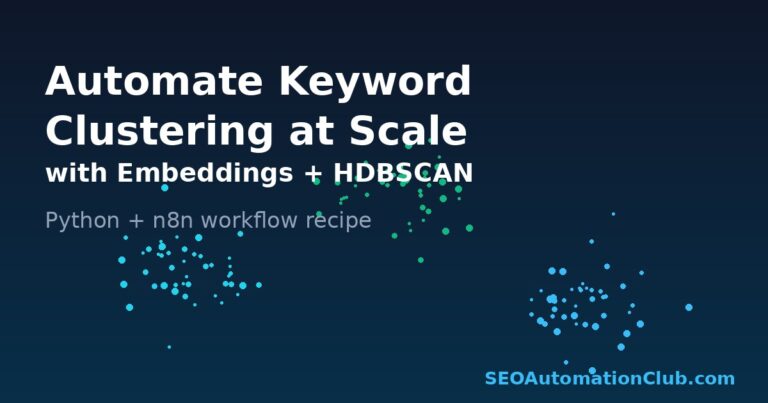
A working Python + n8n pipeline that groups thousands of keywords into content topics by intent using embeddings, UMAP and HDBSCAN.