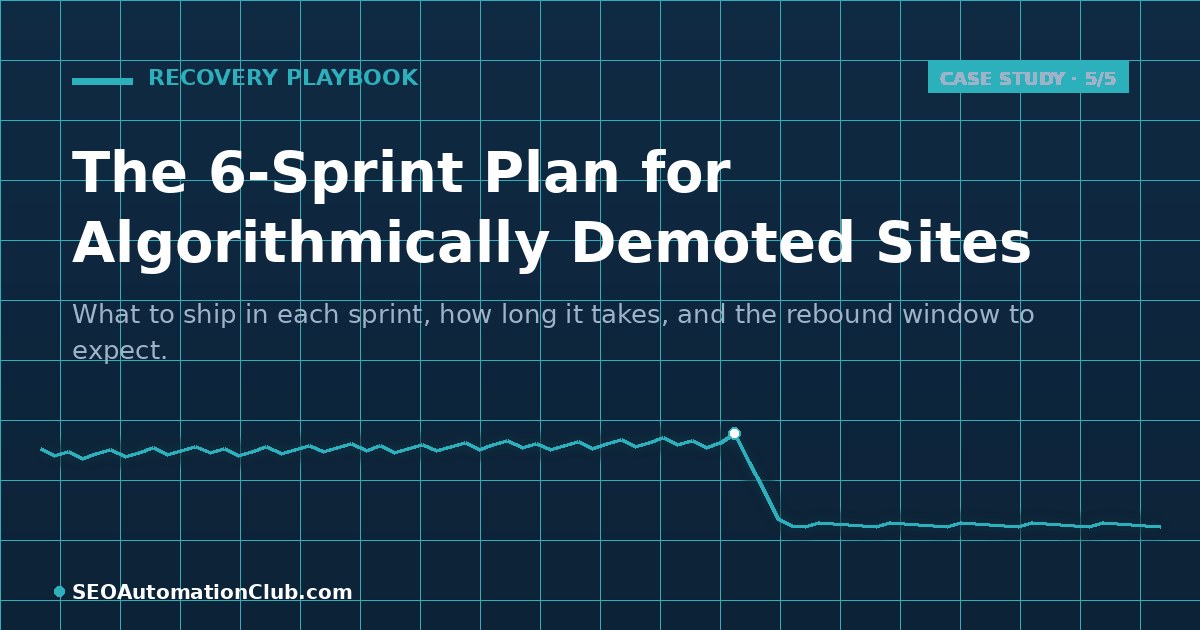
The 6-Sprint Recovery Plan for Algorithmically Demoted Sites
When Google demotes a site algorithmically, there is no form to fill out. There is no reconsideration request. There is no support email that produces a meaningful reply. The only path forward is to dismantle the signature the classifier picked up, install the signals that say “this is a real publisher run by accountable humans,” and wait for the next evaluation cycle to re-score the domain. The waiting is the part most operators handle badly, because it sits on top of weeks of editorial work without immediate feedback.
The plan below is the one we ran on the 1,200-post case study we have been describing across this series. It is structured as six sprints, in order. Each sprint has a defined output, a defined duration, and a defined signal you should watch for. Run them out of order and you waste effort. Run them in order and you give the next quality re-evaluation everything it needs to see.
How to think about recovery before you start
Three principles set up the rest of the plan.
First, signal dismantling comes before signal building. If your site has a templated-content signature, no amount of new author bios, new schema, or new internal linking will outrun the existing signature. The classifier reads the signature first. You have to remove it before you start layering new signals on top.
Second, evaluation cadence is not your cadence. The work you ship in week one does not move traffic in week one. As we covered in the post on the 12-day algorithmic lag, batch re-evaluations for quality signals typically run on a 14- to 21-day window. Plan accordingly: your earliest credible signal arrives in week three, not week one.
Third, partial recovery is the realistic ceiling for the first cycle. Sites that recover from an algorithmic demotion usually do it in stages — a first re-evaluation that takes them from -99% to -70%, a second that takes them to -40%, a third that takes them closer to baseline. Expecting full recovery from the first cycle is the most common reason teams give up on the right plan two weeks before it would have worked.
Sprint 1 — Audit and draft programmatic patterns (Week 1)
Goal: identify every cohort of templated content on the site, score it, and decide what happens to each URL.
What to ship: the audit from the previous post in this series, applied to the full URL list. Slug bucketing, regex pass, structural sampling, the templated-AI rubric, the whitelist of exceptions, and the disposition decision tree for every non-whitelisted URL.
Output: a CSV with one row per URL and one column for the disposition — KEEP, REWRITE, CONSOLIDATE, UNPUBLISH, or REDIRECT.
Duration: three to five days of focused work for a 1,000-URL site. Plan more time at higher URL counts.
Signal to watch: none yet. The output of Sprint 1 is a plan, not a published change. Do not check traffic against this sprint.
Sprint 2 — Install E-E-A-T signals (Week 2)
Goal: make the site readable to the classifier as a publication run by accountable humans rather than a brand voice that nobody is willing to put their name to.
Four pieces ship in this sprint, in order:
- An /about page with the publisher’s mission, the team, and an editorial standards section. This page is the canonical destination for the trust signals you are about to wire into every post.
- Named authors on every post. Replace any “Editorial Team” or generic site-voice byline with a real human who can defend the work. If you only have one author across 800 posts, that is acceptable; the requirement is a named human, not a roster.
- Author bios under every post that link to a dedicated author page and to the /about page. Bios should mention the author’s relevant experience in two or three concrete sentences — “ten years building SEO ops for B2B SaaS portfolios” — not generic credentials.
- Person schema attached to every author bio, linking the author’s
@idto theirurl(the author page) and to any verifiable external profile they have (LinkedIn, X, a conference talk, a paper). ThesameAsarray is the part that makes the schema useful for the classifier.
Duration: three to five days for the page work plus the schema. The bottleneck is usually getting the author to write a real bio.
Signal to watch: still none directly. Trust signals do not move traffic on their own; they are leverage that amplifies the cleanup in Sprint 3.
Sprint 3 — Consolidate clusters and ship dispositions (Weeks 3–4)
Goal: execute every disposition from the Sprint 1 audit, with consolidation done first.
Consolidation is the highest-leverage move in the entire recovery plan. The case-study site had eight clusters of 8–12 templated posts each, all covering subtopics of a single parent topic. We merged each cluster into one deep pillar URL — same domain, new slug, hand-written, structurally varied, sourced — and 301’d every cluster member to its pillar. The result was eight pillar URLs replacing 76 templated ones, with the link equity and topical authority concentrated on URLs that could actually carry it.
After consolidation, ship the rewrites and the unpublishes. Stagger them over a few days rather than on a single weekend; the editorial action log we described in the 12-day delay post reads cleanly only when actions are not bundled into a single day.
Duration: two weeks for a 1,200-URL site with active consolidation work. Faster if your unpublish-to-rewrite ratio is high.
Signal to watch: indexation, not traffic. Within seven days of shipping a consolidation, the surviving pillar URL should be indexed. If it is not, the classifier is signaling that the pillar inherited the same template signature and needs to be reworked before it earns indexation.
Sprint 4 — Reduce AI cadence and change the publishing posture (Week 5)
Goal: change the publishing rate and the publishing process so that the classifier sees a different kind of operation going forward.
The cadence change is one of the most underrated signals in the entire recovery plan. The case-study site had been publishing 70+ posts a month during the burst-publishing months that built the signature. In Sprint 4, we cut the cadence to 8 posts a month, and we changed the upstream process so that every new post had a named author, two named sources, a non-templated structure, and a quality rubric pass before it shipped. The result was a site that, from the classifier’s perspective, looked like a different publisher.
Three changes belong in Sprint 4:
- Cap monthly publishing at a number that allows for genuine editorial supervision — typically 1 post per author per week, not more.
- Retire the templated system prompts that produced the signature. If you keep using AI in the loop — which is fine — change the prompts so that every output requires a different structure, sourcing, and angle.
- Add a publish gate that scores every draft against the quality rubric from the post on why word count won’t save you. Drafts that fail the gate do not ship; they are returned for rewriting.
Duration: one week of process change, ongoing enforcement.
Signal to watch: log the cadence change in the editorial decision log with a 14- to 21-day review window. The first credible recovery signal usually lands inside that window if the cleanup, the trust signals, and the cadence change are all in place.
Sprint 5 — Deep internal linking and topical authority (Weeks 6–7)
Goal: rebuild the internal-link graph so the surviving URLs reinforce each other and present a coherent topical structure to the classifier.
After consolidation, the existing internal links are full of broken paths into URLs you redirected or unpublished, plus a topology that was designed around the templated cohorts you just dismantled. The fix is a from-scratch internal-link pass on the surviving URLs.
Three rules:
- Every pillar URL receives at least five inbound contextual links from the cluster’s surviving posts. Not navigation links; in-body anchor-text links from sentences that warrant the link.
- Every cluster’s surviving posts link to their pillar with descriptive anchor text. “This guide” is weaker than “the guide to canonical tags for paginated archives” — the latter is what the classifier reads as a topical signal.
- Cross-cluster links only when the link is genuinely useful. Linking everything to everything erodes the topical signal you just rebuilt.
Duration: two weeks for a portfolio with eight to twelve pillar URLs. The bottleneck is writing the anchor-text sentences, not the linking itself.
Signal to watch: coverage of the pillar URLs in Search Console — impressions, average position, and indexed-page count. By the end of Sprint 5, every pillar URL should be indexed and showing impressions on its target queries, even if the click numbers are still small.
Sprint 6 — Wait and monitor (Weeks 8–12)
Goal: let the next round of algorithmic re-evaluations land, read the results against the editorial decision log, and resist the urge to ship reactive changes inside the window.
This is the sprint operators handle worst. The work is already done. Traffic is moving slowly or not at all. Internal stakeholders ask for action. The temptation is to ship something — a new redirect rule, a new schema, another round of rewrites — to feel productive. Resist.
What you actually do in Sprint 6:
- Monitor weekly, not daily. Daily traffic is noise; weekly aggregates are the unit that matches the algorithm’s evaluation cadence.
- Watch indexation first, traffic second. The recovery signal you want to see early is that previously unindexed pillar URLs are now indexed and accumulating impressions. Traffic follows.
- Annotate every traffic discontinuity in the editorial decision log as a passive event, even if no editorial action lines up with it. Over weeks 8–12, you will see the cadence at which your domain re-evaluates.
- Plan the next layer. Use the waiting time to outline net-new content that fits the topical authority you just rebuilt. Do not ship it yet; you want the next batch evaluation to see the cleaned-up state, not a fresh batch of new URLs.
Duration: four to twelve weeks. The lower bound assumes a site that was lightly affected and where the cleanup was complete. The upper bound is realistic for a site with the kind of signature we have been describing in this series.
Signal to watch: partial recovery — usually a step from very heavy demotion to moderate demotion — should land inside weeks 6–10 if the work in Sprints 1–5 was correct. Full recovery, where the domain returns to or surpasses pre-demotion levels, is realistic in weeks 12–24 for sites whose underlying topical authority was strong before the templated pipeline drowned it.
A summary timeline
| Sprint | Output | Duration | Signal |
|---|---|---|---|
| 1 — Audit + dispositions | URL × disposition CSV | Week 1 | None |
| 2 — E-E-A-T signals | /about + bios + Person schema | Week 2 | None directly |
| 3 — Consolidate + ship | Pillars, rewrites, redirects | Weeks 3–4 | Indexation of pillars |
| 4 — Cadence + posture | Capped publishing + gate | Week 5 | 14–21d review window opens |
| 5 — Internal linking | Pillar inbound graph | Weeks 6–7 | Impressions on pillars |
| 6 — Wait + monitor | Weekly read of GSC | Weeks 8–12 | Partial → full recovery |
Three failure modes to avoid
Shipping Sprints 1–5 in parallel rather than in order. The sequencing matters because each sprint sets up what the next sprint needs. Author bios shipped before consolidation get attached to URLs that are about to be redirected; internal linking done before consolidation has to be redone after; the cadence change made before the cleanup leaves the templated signature in place at the slower rate.
Reverting the cleanup when traffic does not move in the first two weeks. Two weeks is inside the algorithmic lag window. Traffic that has not moved by day fourteen is the expected state, not a verdict. The case-study site saw no recovery for the first sixteen days after Sprint 3 shipped, then a partial recovery on day twenty-two.
Restarting the AI cadence the moment any recovery shows up. The recovery is fragile. A new burst of templated content during weeks 6–10 will land the site back in demotion at the next re-evaluation, and the second-time recovery is materially harder than the first.
Frequently asked questions
Can I skip Sprint 2 because my site already has author bios?
Probably not. Check whether the bios have Person schema with a populated sameAs array, whether they link to a real author page, and whether the author page is itself indexed. A bio without schema and without an indexed author page is decoration, not signal.
How aggressive should consolidation be?
Conservative on the first pass. If you are torn on whether eight URLs should become one pillar or two, default to two pillars and let traffic data over the next cycle tell you whether to merge further. Reversing a redirect is harder than splitting a pillar later.
Does any of this work if I refuse to reduce my publishing cadence?
The case study suggests no. The cadence change is one of the strongest signals you can send because it is the one that changes the shape of the operation rather than the shape of any individual post. Keeping the old cadence with new processes can work over a long horizon, but the recovery is much slower and less reliable.
What if I have multiple sites with the same signature?
Run Sprints 1–5 on the worst-affected site first, monitor for partial recovery, then begin Sprint 1 on the second site in parallel with Sprint 6 on the first. Trying to recover three sites simultaneously across the same operator usually means none of them get the editorial attention they need.
How will I know when to declare the recovery complete?
When three consecutive weekly aggregates of traffic and impressions are stable at or above the pre-demotion baseline, and when the editorial decision log shows at least two intervening re-evaluations that did not produce a new demotion. Anything earlier is provisional.
What to do next
If your site is currently demoted, start Sprint 1 this week. If your site is not currently demoted but has the signature we described in the first post in this series, the same plan still applies — you are running it preemptively, which is materially cheaper than running it under penalty. Either way, the next algorithmic re-evaluation is already scheduled. The only variable you control is what the classifier sees when it arrives.
Run Sprints 1–5 autonomously across your portfolio
Donna SEO Ops runs the audit, consolidates clusters into pillars, installs E-E-A-T signals, enforces the publish gate, and rebuilds the internal-link graph — across every site in your portfolio, on a schedule. Sprint 6 is yours. Request a free recovery audit →