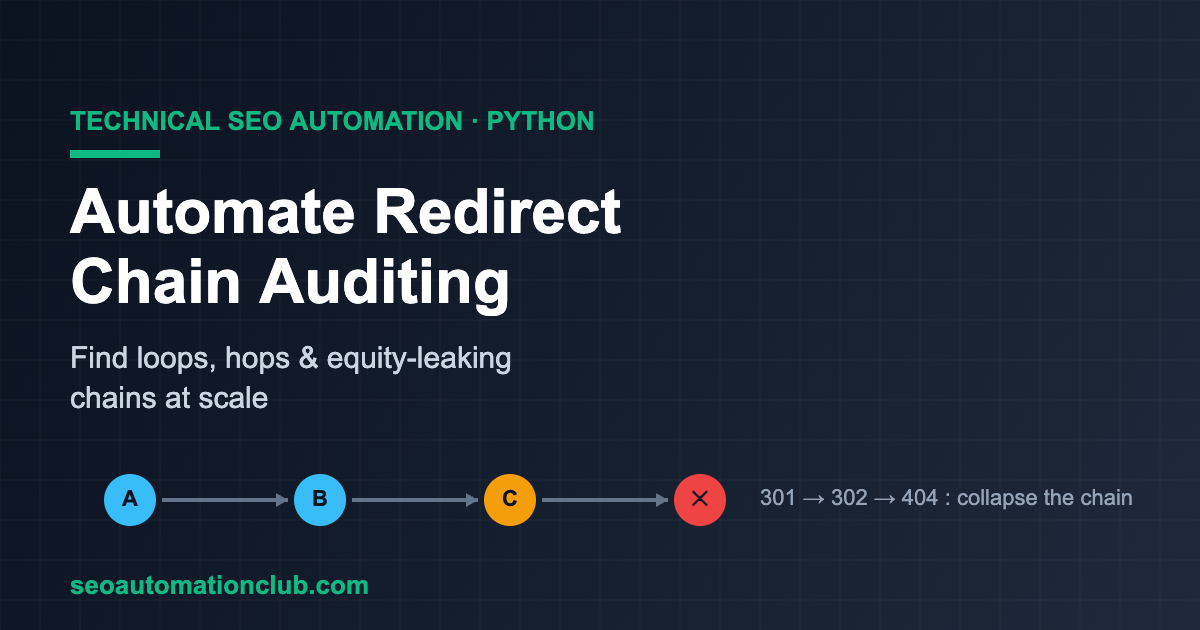
Automate Redirect Chain Auditing With Python: Catch Loops, Hops, and Equity-Leaking Chains at Scale
Most technical SEO teams treat redirects as a one-time chore: set the 301, confirm it fires, move on. But redirects accumulate. A migration here, a slug change there, a plugin that “helpfully” forces trailing slashes, and eighteen months later your site is quietly routing Googlebot through two- and three-hop chains that leak crawl budget, add latency, and dilute link equity. The problem is invisible in a browser because the browser follows the whole chain silently and shows you the final page. You need to inspect the hops, not the destination.
This post builds a Python auditor that crawls your redirects hop by hop, reconstructs the full chain for every URL, and flags the specific hygiene problems that cost rankings: chains longer than one hop, loops, temporary redirects that should be permanent, protocol and trailing-slash hops, and mixed-content transitions. It is deliberately different from building a redirect map for a migration. If you are matching old URLs to new destinations before a relaunch, that is a separate job covered in our redirect mapping pipeline. Here we assume the redirects already exist and we are auditing whether they are healthy.
Why redirect chains quietly cost you rankings
Google will follow up to roughly ten hops before giving up, so a two-hop chain rarely breaks indexing outright. The damage is subtler and cumulative.
How many broken links and redirect chains is your site hiding? Get a free automated audit of your site, delivered to your inbox as a PDF.
Audit my site freeEvery extra hop is another round trip. On mobile connections a single redirect can add 300–600 ms; a three-hop chain turns a fast page into a sluggish one before a single byte of content downloads. Crawl budget is spent on the intermediate 301s rather than on discovering fresh URLs, which matters most on large sites where Googlebot rations its requests. And while Google has said 3xx redirects generally pass signals, each additional hop is another place for something to go wrong: a hop that decays to a 302, a chain that terminates in a soft 404, or a canonical that points back at a redirecting URL.
The worst failure mode is the loop. URL A redirects to B, B redirects back to A, and the page becomes permanently unreachable. Loops usually appear when two systems fight over URL formatting: your CMS forces a trailing slash while a CDN rule strips it. A manual spot check will never catch this at scale, which is exactly why it belongs in an automated audit.
Building the redirect auditor in Python
The core idea is to disable automatic redirect following in requests and walk the chain ourselves, recording every status code, Location header, and URL along the way. That manual walk is what lets us count hops, detect cycles, and classify each transition.
import requests
from urllib.parse import urlparse

HEADERS = {"User-Agent": "Mozilla/5.0 (compatible; RedirectAuditor/1.0)"}
MAX_HOPS = 10
TIMEOUT = 15

def trace_chain(start_url):
    """Follow redirects manually and return the full hop-by-hop chain."""
    chain = []
    seen = set()
    url = start_url

    for _ in range(MAX_HOPS + 1):
        if url in seen:
            chain.append({"url": url, "status": "LOOP", "location": None})
            break
        seen.add(url)
        try:
            resp = requests.get(
                url, headers=HEADERS, allow_redirects=False,
                timeout=TIMEOUT
            )
        except requests.RequestException as e:
            chain.append({"url": url, "status": f"ERROR:{type(e).__name__}",
                          "location": None})
            break

        location = resp.headers.get("Location")
        chain.append({"url": url, "status": resp.status_code,
                      "location": location})

        if resp.status_code in (301, 302, 303, 307, 308) and location:
            url = requests.compat.urljoin(url, location)
        else:
            break

    return chain
Two details matter here. First, allow_redirects=False is what turns a black box into a transparent trace. Second, we resolve relative Location headers with urljoin, because a surprising number of misconfigured servers return a path-only location like /new-page/ rather than a full URL.
Classifying each chain
A raw hop list is data, not insight. The next function turns it into a verdict a human can act on, tagging the issues that actually warrant a ticket.
def classify(chain):
    issues = []
    hops = [h for h in chain if isinstance(h["status"], int)
            and 300 <= h["status"] < 400]
    hop_count = len(hops)
    final = chain[-1]

    if any(h["status"] == "LOOP" for h in chain):
        issues.append("redirect_loop")
    if hop_count >= 2:
        issues.append(f"chain_{hop_count}_hops")
    if any(h["status"] in (302, 303, 307) for h in hops):
        issues.append("temporary_redirect")

    # Protocol and host hygiene across the chain
    for a, b in zip(chain, chain[1:]):
        if not b.get("location"):
            continue
        pa, pb = urlparse(a["url"]), urlparse(a.get("location") or "")
        if pa.scheme == "https" and pb.scheme == "http":
            issues.append("https_to_http_hop")
        if a["url"].rstrip("/") == (a.get("location") or "").rstrip("/") \
           and a["url"] != a.get("location"):
            issues.append("trailing_slash_hop")

    if isinstance(final["status"], int) and final["status"] >= 400:
        issues.append(f"dead_end_{final['status']}")

    return {
        "start": chain[0]["url"],
        "final": final["url"],
        "hops": hop_count,
        "final_status": final["status"],
        "issues": issues or ["ok"],
    }
Notice the https_to_http_hop check. A chain that dips to http even for a single intermediate hop creates a mixed-content transition and an insecure request that browsers and crawlers both dislike. These are among the most common findings on older sites, and they never surface in a normal browser test.
Running it against a list of URLs
Feed the auditor your live URLs, ideally the ones that already have inbound links or organic clicks. Export your top pages from Search Console, or pull the <loc> entries from your XML sitemap, then run them through a thread pool so the audit finishes in minutes rather than hours.
import csv
from concurrent.futures import ThreadPoolExecutor

def audit(urls, workers=10):
    results = []
    with ThreadPoolExecutor(max_workers=workers) as pool:
        for chain in pool.map(trace_chain, urls):
            results.append(classify(chain))
    return results

def to_csv(results, path="redirect_audit.csv"):
    with open(path, "w", newline="") as f:
        w = csv.writer(f)
        w.writerow(["start", "final", "hops", "final_status", "issues"])
        for r in results:
            w.writerow([r["start"], r["final"], r["hops"],
                        r["final_status"], "|".join(r["issues"])])

if __name__ == "__main__":
    urls = [line.strip() for line in open("urls.txt") if line.strip()]
    to_csv(audit(urls))
The redirects this script cannot see
An HTTP-level auditor catches server-side 3xx redirects, which is the vast majority of what matters. But two kinds of redirect happen after the response body arrives, and a headers-only crawl is blind to both. A meta-refresh redirect (<meta http-equiv="refresh" content="0;url=...">) lives in the HTML, and a JavaScript redirect (window.location = ...) only fires when the page executes. Google can follow both, but treats them as weaker signals than a clean 301, so finding them is genuinely useful.
You can extend the auditor to flag these without a full headless browser: when a chain terminates in a 200, parse the returned HTML for a meta-refresh tag and for obvious location assignments in inline scripts. Anything you find there is a redirect that should be a server-side 301 instead. If a page relies on JavaScript that only a real browser would run, escalate just those URLs to a Playwright pass rather than rendering your entire URL set, which keeps the audit fast while still catching the stragglers.
Reading the results like an SEO, not a script
The CSV will sort your problems into a short priority list. Here is how to triage what comes back.
| Finding | Severity | Fix |
|---|---|---|
| redirect_loop | Critical | The page is unreachable. Find the two rules fighting over the URL and remove one. |
| dead_end_404 / 410 | Critical | Redirect points at a missing page. Repoint to the closest live equivalent. |
| chain_2_hops+ | High | Collapse the chain: point the first URL directly at the final destination. |
| temporary_redirect | Medium | If the move is permanent, switch 302/307 to 301/308 so signals consolidate. |
| https_to_http_hop | Medium | Rewrite the intermediate rule to stay on https end to end. |
| trailing_slash_hop | Low | Normalize slash handling in one place to stop the extra hop. |
The single highest-value action is almost always collapsing chains. When URL A → B → C, edit the rule for A so it targets C directly. Do the same for B. This is safe, reversible, and immediately removes a wasted round trip for every crawler and visitor. Re-run the audit after each batch of fixes to confirm the chains actually shortened rather than moving the problem somewhere else.
Where this fits in a broader technical program
Redirect hygiene rarely lives alone. A dead-end redirect is really a broken-link problem, so pair this with automated broken-link and 404 monitoring to catch the destinations that rot over time. And because a redirect that terminates on a page whose canonical points elsewhere sends a contradictory signal, run this alongside canonical tag auditing so your redirects and canonicals agree on the one true URL. Wire all three into a weekly scheduled job and redirect drift stops being something you discover during a traffic drop and becomes something you fix before it matters.
Frequently asked questions
How many redirect hops are actually harmful?
One hop is normal and fine. Google follows up to roughly ten before giving up, but real-world impact starts at two: every extra hop adds latency, spends crawl budget, and creates another point of failure. Treat any chain of two or more hops as something to collapse.
Do 301 redirects still lose PageRank?
Google has stated that 301 redirects generally pass signals without loss, and 308 behaves the same way for permanent moves. The practical risk is not a fixed "percentage lost" but the compounding fragility of long chains, temporary redirects that never get made permanent, and hops that decay into errors. Keeping chains short and permanent is what protects the signal.
Why not just use a full crawler like Screaming Frog?
General crawlers are excellent and will surface redirect chains too. A focused script wins when you want redirect hygiene checked continuously and automatically: it runs headless on a schedule, outputs a clean CSV you can diff week over week, and integrates into pipelines without a desktop application or per-seat licensing.
Should I audit with a Googlebot user agent?
Audit with a normal user agent first, since that reflects what most visitors experience. Then re-run key URLs with a Googlebot user agent if you suspect user-agent-specific redirect rules, which are common on sites with geo or device targeting. Discrepancies between the two runs are themselves a finding worth investigating.
How often should this run?
Weekly is a sensible default for most sites, with an on-demand run immediately after any migration, CMS update, or CDN rule change, since those are the events that introduce new chains and loops in the first place.
How many broken links and redirect chains is your site hiding?
Get a free audit of your internal links, broken URLs, redirect chains and orphan pages, with a prioritized fix list.
Rather have it handled for you? See Donna’s plans →