The 12-Day Delay: Why Editorial Cleanup Backfires Late
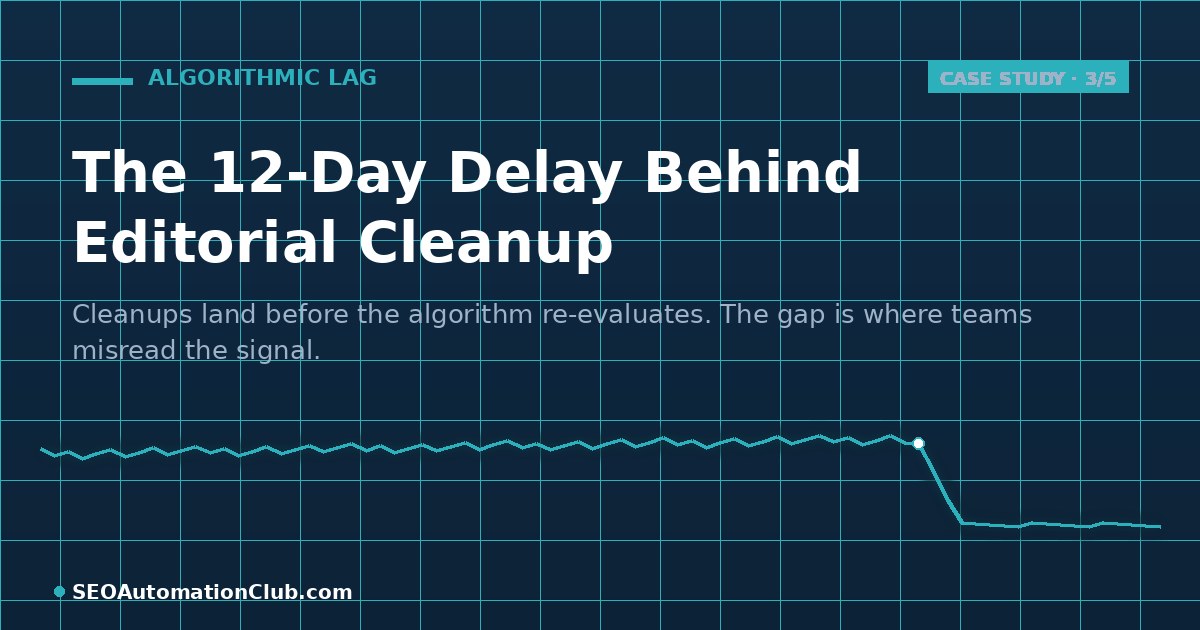
On May 23, a content team we worked with finished a long-running cleanup project. They had identified 363 thin, duplicate, and templated posts across a 1,200-post portfolio, and they unpublished or merged all of them in a single coordinated sweep. By the end of that Saturday, the site looked materially leaner. The team logged the work, took the weekend off, and went back to the publishing calendar on Monday.
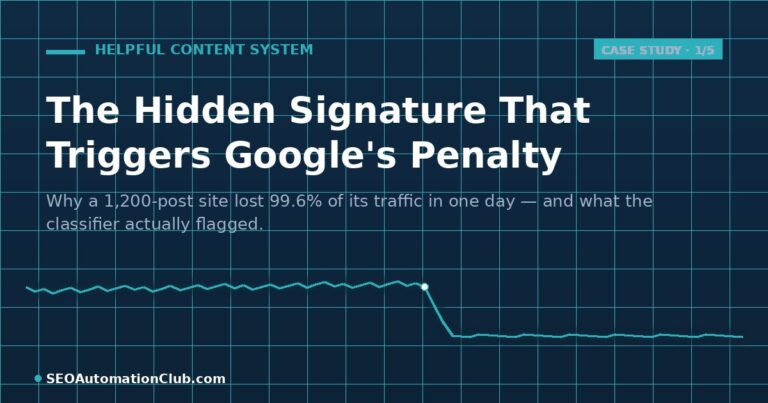
Thirteen days later, on June 5, the site lost 99.6% of its traffic in a single day.
The first reaction from inside the team was the one almost every operator has in this situation: the cleanup broke something. Maybe a redirect was misconfigured. Maybe a robots rule got flipped. Maybe a plugin update timed wrong. None of those things had happened. The cleanup had completed correctly, the technical health of the site was intact, and Search Console showed no manual action. What the team was actually watching was something more mundane and more dangerous: an algorithmic re-evaluation arriving on its own clock, two weeks after the editorial work that ought to have prevented it.
This post is about that lag — why it happens, why it produces a specific class of misdiagnosis, and how to instrument your editorial process so that you can tell the difference between “we broke something on May 23” and “Google finished re-evaluating us on June 5.”
Why algorithmic re-evaluation is not real-time
Google’s quality systems do not score your site every time you push a change. They batch. The Helpful Content classifier — which since the March 2024 core integration is part of the broader ranking system rather than a separate update — re-scores sites on a cadence that, based on a growing body of operator observation, runs in roughly two-to-three week windows for content quality signals. That cadence is not a published number, but it is a remarkably consistent one across recovery and demotion cases we have analyzed.
What this means practically: when you make a quality-related change on day zero, the next re-evaluation that includes your site might run any time between day fourteen and day twenty-one. The cleaned-up state of your site does not “go live” the moment you ship it. It sits in Google’s index waiting for the next batch evaluation, and the verdict — positive or negative — lands then.
The same lag works in both directions. If your cleanup was correct, the recovery shows up two-to-three weeks later, not the day after. If your cleanup was incomplete, the penalty still arrives on the algorithm’s schedule, not your editorial calendar.
The dangerous gap between action and signal
The two-week lag opens a window that destroys editorial decision-making if you are not aware of it. Here is the shape it takes in practice.
On day zero, the team ships a major editorial change — say, unpublishing 300 thin posts. The team feels productive. The site looks cleaner. Internal stakeholders are notified that the cleanup is done. Everyone moves on.
On day eight, traffic looks fine. The team interprets this as “the cleanup didn’t hurt us.” On day twelve, traffic is still fine, so the team starts the next initiative. On day fourteen, an algorithmic re-evaluation lands. If it is a negative verdict, traffic falls. The team’s immediate hypothesis is that whatever change they shipped on day twelve or day thirteen broke something. They roll back day thirteen’s change, traffic does not recover, and they spend a week debugging the wrong thing.
The same pattern happens with positive verdicts. A team that shipped a quality cleanup on day zero often gives up on it by day ten because they “didn’t see recovery.” Then a different change lands on day fifteen, traffic recovers on day eighteen, and the team attributes the recovery to the wrong action. The misattribution leaves them with no idea what is actually working, and they double down on the wrong lever.
What the case study looked like in detail
Here is the timeline of the case we have been describing across this series, reconstructed after the fact:
| Date | Action | Traffic state |
|---|---|---|
| Aug–Nov 2025 | Burst publishing: 287 posts in 4 months from a templated pipeline | Stable, then plateau |
| Jan 2026 | Internal quality concerns raised | Slight softening |
| May 23, 2026 | Editorial cleanup: 363 duplicates/thin posts removed in one day | No visible change |
| May 24 – Jun 4 | No major editorial actions | Stable |
| Jun 5, 2026 | Algorithmic re-evaluation lands | -99.6% in one day |
The cleanup on May 23 was the right action. The problem was that it was both too late — the templated signature had been accumulating for nine months by the time the team responded — and too narrow: removing 363 posts dropped the templated-content ratio from 50% to 35%, which was still high enough for the classifier to flag the site at the next evaluation. The team did not get credit for the cleanup because the cleanup was incomplete. But the timing of the demotion, twelve days after the cleanup, made the team initially suspect their own correct action.
This is the failure mode the lag produces: correct actions look incomplete; incomplete actions look correct; and the team is unable to tell which is which without instrumentation.
How to instrument editorial actions so you can read the signal
The fix is not technical. It is procedural. You need a decision log that gives every meaningful editorial action a timestamp, a description, an expected effect, and a window in which that effect should land. When traffic moves, you correlate the move against the log rather than against your most recent memory.
A minimal log has six columns:
date         action_id   action_type   scope                expected_effect           review_window
2026-05-23   #A-118      cleanup       363 thin posts        +2-5% on retained URLs   Jun 6 - Jun 20
2026-06-05   —           (passive)     algorithmic re-eval   demotion confirmed       —
2026-06-08   #A-119      structural    H2 outlines varied    no traffic effect alone  Jun 22 - Jul 6
2026-06-12   #A-120      EEAT          Author bios + schema  +1-3% via author trust   Jun 26 - Jul 10
Three rules make this log useful rather than ceremonial.
Rule 1 — every editorial action gets a row. Including cleanups, structural changes, schema additions, internal-link rewires, and changes to the publishing cadence. Especially the cadence changes; we will come back to those.
Rule 2 — the review window is always two to three weeks out. Not “let’s check next week.” The window has to match the algorithmic re-evaluation cadence or the log is lying to you about when effects should appear.
Rule 3 — passive events get rows too. When you see a discontinuity in traffic that does not correspond to any editorial action you took, log it as a passive event. Tag it as “candidate algorithmic re-evaluation.” The next time you ship a cleanup, you will have a reference for how the cadence works on your specific domain.
The cadence change is the action most operators forget to log
Cleanup is the obvious editorial action. Schema additions are obvious. What is less obvious — and what we see operators forget — is that changing your publishing cadence is itself an editorial action, and one of the strongest signals you can send. A site that has been publishing 70 posts a month from a templated pipeline and then suddenly drops to 8 posts a month is doing something the classifier will read in the next batch evaluation. That cadence change deserves a row in the log, with a review window, just like any other action.
Operators who skip this row end up confused when a traffic shift two-to-three weeks later does not line up with any “action” they logged, because they were not thinking of the cadence reduction as one.
How to read traffic during the lag
Three patterns are worth knowing during the lag window between an editorial action and its expected re-evaluation.
Flat is the expected pattern. If your traffic does not move at all in the first ten days after a cleanup, that is the most common outcome and it tells you nothing about whether the cleanup worked. Do not interpret flatness as a verdict.
A late drop is consistent with an unrelated re-evaluation arriving on schedule. If you cleaned up on day zero and traffic falls on day twelve, do not assume the cleanup caused it. Check the calendar against your previous re-evaluations and against industry-wide volatility trackers; the drop is far more likely to be a coincident batch verdict than a delayed consequence of your editorial work.
A late recovery is consistent with a previously-shipped action finally registering. If you cleaned up on day zero and traffic recovers on day eighteen with no intervening change, the cleanup is almost certainly what re-scored. Resist the temptation to credit whatever else you happened to do on day fifteen.
Frequently asked questions
Is the 12-day lag a guaranteed number?
No. Twelve days is what this case study showed. The broader pattern across cases we have analyzed clusters in a two-to-three week window, but the exact lag for your site depends on how often Google’s quality systems batch evaluations for sites of your size and content profile. Plan for fourteen to twenty-one days; do not be surprised by either extreme.
Can I force a re-evaluation faster?
No. There is no equivalent of the reconsideration request for algorithmic verdicts. The “URL Inspection” tool will re-fetch a page, but it does not trigger a quality re-evaluation of your domain. The only thing you can control is the quality state of the site when the next evaluation lands.
Does the lag explain the “I fixed it but traffic is still dropping” complaint?
Frequently, yes. Most operators in that situation are interpreting flatness or noise in the first two weeks as evidence that the fix failed. Once you account for the lag, the more accurate read is usually “the next re-evaluation has not happened yet, and the data we have so far does not tell us whether the fix worked.”
Should I avoid shipping multiple editorial actions at once?
Yes, where you can. If you ship five changes on the same day, the next re-evaluation gives you one verdict that bundles all five together, and you cannot isolate which one drove the result. Where the work allows it, stagger meaningful actions by at least a week so that subsequent re-evaluations can resolve them independently.
How does this interact with manual editorial improvements on individual pages?
The same lag applies. A rewritten post does not re-score the day you republish it; it re-scores at the next quality evaluation that includes your site. Per-page improvements are still valuable, but you should expect the visibility effects to land in cohorts, not page-by-page in real time.
What to do next
Set up the decision log this week. Backfill it for the last ninety days. Annotate any traffic discontinuities you see in that history with the action — or the absence of an action — that lines up with them. Once you have a few cycles of data, you will know your domain’s specific re-evaluation cadence, and the lag stops being a source of confusion.
If you have not yet identified what triggered a demotion on your own site, start with the signature audit from the first post in this series. The decision log is the second tool; the diagnosis is the first.
Keep the editorial action log automatically
Donna SEO Ops timestamps every meaningful editorial action across your portfolio — cleanups, structural changes, schema additions, cadence shifts — and reads traffic discontinuities against that log so you stop misattributing late-arriving algorithmic verdicts. Request a free decision-log review →