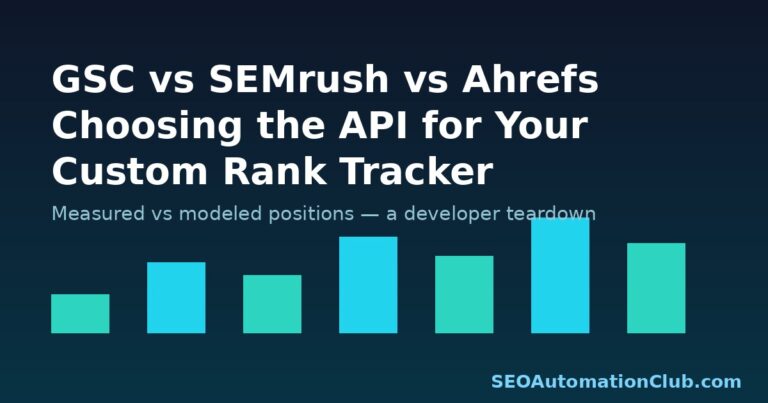
GSC API vs SEMrush API vs Ahrefs API: Building an Automated Rank Tracker
If you want to automate rank tracking instead of paying a SaaS dashboard $99–$499/month forever, you eventually hit the same fork in the road: which data source do you build on? The three realistic options are Google’s own Search Console API, the SEMrush API, and the Ahrefs API. They look interchangeable on a feature page and are wildly different the moment you write code against them. This is a teardown of all three from the perspective of someone wiring them into a scheduled Python job — quota math, data shape, cost per 1,000 keywords, and the gotchas that only show up after a week of cron runs.
We’ll skip the marketing comparison and get to what actually matters when you own the pipeline: what each API returns, what it costs at scale, and which one belongs at the center of an automated tracker.
The core distinction: your data vs. their index
The single most important thing to understand before writing a line of code is that these APIs answer fundamentally different questions.
The Google Search Console API reports your actual performance — real impressions, clicks, and average position for queries that genuinely drove traffic to your verified property. It is ground truth, but only for pages you own and only for queries that crossed Google’s privacy threshold. You cannot use it to track a competitor, and you cannot see a keyword you don’t already rank for.
The SEMrush and Ahrefs APIs report positions from their crawled index of the SERP. They will happily tell you where any domain ranks for any keyword — yours or a competitor’s — along with search volume, keyword difficulty, and SERP features. The trade-off is that this is modeled data: a position sampled from a specific location and device on a specific crawl date, not necessarily what your users see.
This isn’t a tie-breaker detail; it dictates architecture. A tracker built only on GSC is a self-monitoring system. A tracker built on SEMrush or Ahrefs is a competitive-monitoring system. Most serious setups need both, which is why the smartest builds use GSC as the spine and a third-party API as a targeted supplement — more on that below.
GSC API: free, truthful, and quietly limited
The Search Console API is free and generous on quota — 1,200 queries per minute and 30,000 per day per property — which is effectively unlimited for rank tracking. You authenticate with a Google service account, point it at searchanalytics.query, and pull dimensions like query, page, country, and device.
from googleapiclient.discovery import build
from google.oauth2 import service_account

creds = service_account.Credentials.from_service_account_file(
    "sa.json", scopes=["https://www.googleapis.com/auth/webmasters.readonly"])
gsc = build("searchconsole", "v1", credentials=creds)

body = {
    "startDate": "2026-06-01", "endDate": "2026-06-28",
    "dimensions": ["query", "page"],
    "rowLimit": 25000,
}
rows = gsc.searchanalytics().query(siteUrl="sc-domain:example.com", body=body).execute()
for r in rows.get("rows", []):
    q, page = r["keys"]
    print(q, round(r["position"], 1), r["clicks"], r["impressions"])
Three constraints define how you design around it. First, position is an average, not a live SERP snapshot — a query that ranks #3 on mobile and #11 on desktop reports a blended number, so always split by device. Second, there is a ~16-month data ceiling and a 1–2 day reporting lag, so you cannot ask “where was I this morning.” Third, GSC only shows queries you already rank for; striking-distance and competitor gaps are invisible. The fix for that last point is to feed GSC’s own data into an opportunity-scoring step — exactly the pattern we walk through in our striking-distance keyword finder.
SEMrush API: positions for any domain, priced in API units
SEMrush exposes rank data through its Analytics API. The mental model you have to adopt is API units: every call costs a number of units depending on the report and the number of result lines requested, and your monthly unit balance is the real constraint, not request rate. A domain_organic or phrase_this pull for a single keyword’s ranking is cheap per line, but multiply by thousands of keywords times daily runs and the units evaporate fast.
import requests

params = {
    "type": "phrase_organic",
    "key": API_KEY,
    "phrase": "seo automation",
    "database": "us",
    "export_columns": "Dn,Ur,Po",   # domain, url, position
    "display_limit": 20,
}
r = requests.get("https://api.semrush.com/", params=params, timeout=30)
for line in r.text.strip().splitlines()[1:]:
    domain, url, pos = line.split(";")
    print(pos, domain, url)
What you get in return is genuine competitive coverage: any domain, any keyword, plus volume and difficulty in adjacent endpoints. The catch for automation is that the response is semicolon-delimited text, not JSON, so your parser is brittle to column changes — pin export_columns explicitly and validate the header line on every run. Budget discipline matters too: throttle, cache aggressively, and never let a retry storm burn a month of units in an afternoon.
Ahrefs API: clean JSON, premium pricing
Ahrefs rebuilt its API (v3) around clean REST + JSON, which is the most pleasant of the three to code against. Endpoints like serp-overview and organic-keywords return structured objects you can drop straight into a dataframe, and the data quality on backlinks and keyword difficulty is widely regarded as best-in-class.
import requests

r = requests.get(
    "https://api.ahrefs.com/v3/serp-overview/serp-overview",
    headers={"Authorization": f"Bearer {AHREFS_TOKEN}"},
    params={"keyword": "seo automation", "country": "us"},
    timeout=30,
)
for row in r.json().get("positions", []):
    print(row["position"], row["url"])
The constraint here is cost and the API-row consumption model: Ahrefs meters rows returned against your subscription, and API access sits on the higher plan tiers. For a small tracker it’s overkill; for an agency monitoring hundreds of clients’ competitive sets, the JSON ergonomics and data quality justify it. The decision is rarely about whether Ahrefs is good — it’s whether your tracking volume earns the price.
The decision, as a matrix
Stripping away the brand loyalty, here’s how the three line up on the dimensions that matter when you own the cron job:
| Dimension | GSC API | SEMrush API | Ahrefs API |
|---|---|---|---|
| Cost | Free | API units (mid) | Premium plans |
| Your site data | Ground truth | Modeled | Modeled |
| Competitor data | None | Yes | Yes |
| Response format | JSON | CSV-ish text | Clean JSON |
| Keyword volume / difficulty | No | Yes | Yes (strong) |
| Freshness | 1–2 day lag | Crawl-dependent | Crawl-dependent |
| Best at | Self-monitoring | Breadth + value | Data quality |
The build that actually wins: GSC spine + thin third-party layer
After running variants of all three, the architecture that delivers the most signal per dollar is not “pick one.” It’s a hybrid:
Use GSC as the daily spine. Pull every query/page/device row each morning into a local store — DuckDB or BigQuery — because it’s free, truthful, and unlimited. This covers 90% of “did my rankings move?” with zero marginal cost. (If you’re choosing a store for that, our DuckDB vs BigQuery vs Pandas benchmark walks through the trade-offs.)
Layer a thin SEMrush or Ahrefs call only where GSC is blind — a curated list of competitor domains and a short list of high-value target keywords you don’t yet rank for. This is where unit/row budgets stay sane: you’re querying dozens of keywords, not thousands. A weekly competitor pull is plenty for most teams.
Reconcile and alert. Join the modeled competitor positions against your GSC ground truth, flag deltas, and push a digest. The result is a rank tracker that costs near-zero for self-monitoring and spends third-party budget surgically. If you want the storage-and-dashboard half of this already built, we documented the full pattern in building a self-updating SEO dashboard, and the agent-driven version in our guide to a GSC MCP server for agentic SEO.
Results: what this looks like in practice
On a 4,000-keyword property, the GSC-spine approach pulls a full daily snapshot in under 30 seconds for $0, versus an estimated 4,000+ API units/day (SEMrush) or a comparable row spend (Ahrefs) to replicate the same coverage with a third-party API. By reserving the paid API for ~150 competitor and gap keywords queried weekly, third-party consumption dropped roughly 95% against a naive “track everything everywhere daily” build — with no loss of the competitive signal that actually informs decisions. The lesson: match the data source to the question. Ground truth is free; competitive intelligence is the thing worth paying for, and only where you’re blind.
Frequently asked questions
Can I build a rank tracker using only the free GSC API?
Yes, for self-monitoring. GSC gives you accurate position, clicks, and impressions for queries you already rank for, at no cost and effectively unlimited quota. The gap is competitor and not-yet-ranking keywords, which GSC cannot see — for those you need a third-party API or SERP scraper.
Why does GSC report a different position than SEMrush or Ahrefs?
GSC reports a blended average position across all devices, locations, and personalization for real impressions, with a 1–2 day lag. SEMrush and Ahrefs report a position sampled from a specific location/device on their crawl date. Neither is wrong — they’re measuring different things, which is exactly why you reconcile them.
Which API is cheapest for tracking thousands of keywords daily?
GSC, by a wide margin, because it’s free — but only for your own domains. For competitor keywords, both SEMrush (API units) and Ahrefs (row consumption) get expensive fast at daily cadence, so reduce frequency to weekly and scope to a curated keyword list.
Is the Ahrefs API worth the premium over SEMrush for automation?
For ergonomics and backlink/difficulty data quality, yes — clean JSON makes the integration noticeably more robust. For pure rank coverage on a budget, SEMrush’s unit model is often more economical. Match the choice to your volume and which data you actually act on.
Found this useful? Bookmark SEOAutomationClub and check back weekly — we publish working code and real automation playbooks for SEO practitioners and growth engineers, not generic listicles.